
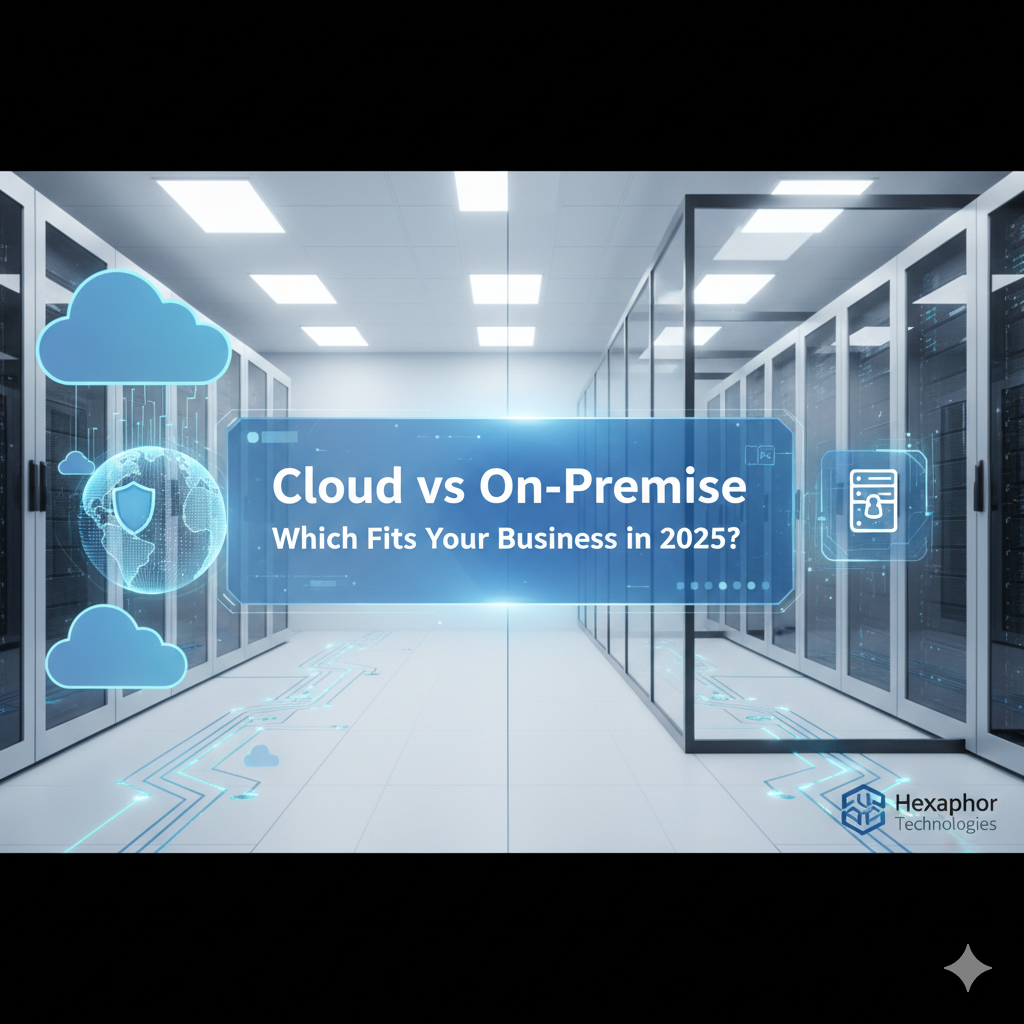
In an era where digital agility, business continuity and cost-efficiency are paramount, choosing the right IT infrastructure model has become a decisive factor for organisations—especially in India where market dynamics and regulatory landscapes are evolving rapidly. At Hexaphor Technologies, we believe the question isn’t “which model is always best” but rather “which model best fits your business today and for 2025”. This blog explores two foundational models—cloud computing and on-premise infrastructure—and guides you through their advantages, disadvantages, security considerations and cost implications so you can make an informed choice for your business.
On-Premise IT Infrastructure refers to hardware, software, storage and networking resources that your organisation owns, hosts and manages on its own site or dedicated data centres. You retain full physical control over equipment, data location and maintenance.
Cloud Computing refers to IT services delivered over the internet — from servers and storage to applications — typically provided by third-party cloud service providers. You pay for what you use and gain access to scalable, on-demand resources.
In 2025, Indian businesses face a critical decision: maintain full control and predictability with on-premise, or embrace agility, scalability and modernisation with cloud deployment.
Scalability & Flexibility
One of the biggest advantages of cloud computing is its ability to scale resources up or down quickly according to business demand. Whether you’re experiencing seasonal spikes or launching new services, cloud deployment gives you the agility to respond fast without major upfront investment.
Lower Up-Front Costs
In contrast to on-premise infrastructure where you invest capital upfront in servers, cooling, space and wiring, cloud computing shifts the cost model to operational expenditure. You subscribe or pay-as-you-use, which can be beneficial for growing Indian enterprises.
Faster Time to Market & Innovation
Cloud platforms offer access to ready-built services—analytics, machine learning, data-lakes—that you might not easily deploy on-premise. This accelerates digital initiatives, enabling your business to deliver new features and services faster.
Geographic Reach & Remote Access
With cloud computing, your team and customers can access services from anywhere. For Indian businesses increasingly working with remote teams, multiple locations and global partners, this becomes a strategic advantage.
Managed Infrastructure & Reduced Maintenance
Cloud providers handle infrastructure maintenance, updates, security patches and backups. This means your IT team can focus more on business innovation rather than hardware upkeep.
Full Control & Customisation
On-premise gives you complete ownership of hardware, data location, software stack and security protocols. For businesses in India with highly custom-built legacy systems or requiring very specific compliance, this level of control matters.
Predictable Performance & Low Latency
Because infrastructure is local, on-premise systems can deliver consistent performance and extremely low latency. If your operations demand real-time processing and minimal round-trip delays, on-premise may fit better.
Data Sovereignty & Regulatory Compliance
In regulated sectors—banking, finance, healthcare—having your data on-site may simplify compliance with data-protection laws and audits. India’s regulatory environment is evolving, so on-premise infrastructure offers visible, physical data control.
Avoiding Ongoing Variable Costs
While on-premise requires upfront capital, once infrastructure is in place and well-utilised, your ongoing costs may stabilise. For steady workloads with little variability, this can lead to predictable cost profiles.
Cloud Computing – Key Disadvantages
Dependency on Internet / Connectivity: If your business location suffers from unstable internet, cloud access may be impacted.
Data-migration & Vendor Lock-in: Moving from one provider to another or repatriating large data sets can be complex and costly.
Variable Costs: While upfront cost is low, usage-based billing can accumulate fast, especially if not optimised.
Customisation Limitations: Some cloud environments may not allow the deep level of customisation possible on-premise.
On-Premise Infrastructure – Key Disadvantages
High Upfront Capital Expenditure (CapEx): Buying servers, storage, cooling, power and space can be expensive.
Slower Scaling: To scale, you must purchase and install new hardware—this can be time-consuming and limiting.
Maintenance Burden: The business bears responsibility for hardware failures, software updates, backups and security.
Risk of Under-Utilisation: If you over-invest in capacity that’s seldom used, you incur wasted expenses.
Security is a top concern — for Indian businesses handling sensitive customer data, intellectual property or regulatory compliance, choosing the right infrastructure model is essential.
Cloud Security
Modern cloud providers invest heavily in physical security, network security, encryption and global data centres. With the shared-responsibility model, they manage infrastructure security while you manage data and access.
Benefits include built-in disaster recovery, replication and high availability.
However, you need to ensure data encryption, identity & access management, regular audits and compliance alignment.
On-Premise Security
On-premise gives you full control over security stack—physical access, hardware, custom encryption, in-house teams. This can be beneficial if you have strong internal IT and security capability.
But the burden of keeping systems patched, backed up and monitored rests entirely with you. The risk of outdated hardware or under-resourced security teams is real.
Compliance & Data Location
For Indian businesses operating under laws like the Information Technology Act, personal data protection, or sector-specific regulations, the question of where data is stored and who has access becomes important. On-premise offers maximum visibility; cloud deployments need rigorous provider-due diligence and clear SLAs.
At Hexaphor Technologies, we help businesses evaluate both models, design secure architectures and implement solutions that maintain compliance while delivering performance.
When you compare costs, you must look beyond just initial spend. Let’s break it down:
On-Premise Costs Include:
Capital expenditure: servers, storage, networking gear, data-centre space, power & cooling.
Operational expenditure: IT staff, maintenance, upgrades, depreciation, spare parts.
Scaling expense: adding new hardware often means downtime or installation time.
Risk of over-provisioning: building for peak usage may mean unused capacity.
Cloud Costs Include:
Subscription or pay-as-you-use fees for compute, storage, and network.
Which is more cost-effective?
It depends on your workload, growth pattern and business model. For example:
If your workload is highly variable and you need to scale up and down often, cloud may deliver better cost-efficiency.
If you have a predictable, stable workload and strong in-house infrastructure, on-premise might be more predictable and cost-effective in the long run.
At Hexaphor Technologies, we help you run a total cost of ownership (TCO) analysis tailored to your Indian business context and project growth to 2025 and beyond.
To decide between cloud vs on-premise, consider these key criteria:
Growth Trajectory & Workload Variability
Rapid growth, seasonal demand, new digital products → lean toward cloud.
Stable workload, strong existing infrastructure, need for custom environment → consider on-premise.
Control, Customisation & Compliance Needs
High regulatory burden, highly specialised hardware, strict latency needs → on-premise may win.
Need for agility, remote workforce, global reach → cloud is attractive.
Budget & Cost Model Preferences
Want lower upfront investment and pay-as-you-use → cloud.
Have budget for infrastructure and want predictable long-term costs → on-premise.
Security & Data Sovereignty
Sensitive data, local residency, full control required → on-premise.
Talent & Operational Capability
Have strong IT team and hardware operations in-house → on-premise feasible.
Prefer vendor-managed infrastructure and less operational burden → cloud.
Hybrid & Multi-Cloud Approach
Increasingly, the best fit is not “cloud OR on-premise” but “cloud AND on-premise” — a hybrid model that gives you the best of both worlds. You may keep mission-critical systems on-premise while running other workloads in the cloud. This gives flexibility, control and scalability balanced.
At Hexaphor Technologies, we design hybrid architectures that allow Indian businesses to transition smoothly and leverage cloud computing while retaining on-premise control where it matters most.
In 2025, Indian businesses are accelerating cloud adoption. With digital initiatives, remote workforce, regulatory pressures and the rise of SaaS, the demand for cloud computing India is stronger than ever. The term “business cloud 2025” captures the trend of full-scale digital operations, hybrid infrastructures and data-driven models becoming the norm.
Cloud computing solutions India must thus consider local data-centre availability, regional latency, compliance with Indian regulations and cost-efficiency in the Indian rupee context. Hexaphor Technologies’ solutions cater specifically to Indian businesses—offering secure cloud hosting, local support, and optimized cost models tailored for growth.
When moving forward with either cloud, on-premise or hybrid, keep these best practices in mind:
Define clear business goals: Are you seeking speed to market, compliance, cost savings or innovation?
Perform workload analysis: Which applications are good candidates for cloud vs on-premise?
Plan for security from day one: Regardless of model, embed security, access controls, encryption and auditing.
Focus on cost governance: In cloud especially, monitor usage and optimise resources to avoid cost surprises.
Design for hybrid flexibility: Build your architecture so workloads can move between on-premise and cloud if required.
Train your teams: A digital-ready culture will make transformation faster and more effective.
Choose the right partner: With Hexaphor Technologies, you get end-to-end support—from strategy and deployment to operations and optimisation.
There’s no one-size-fits-all answer. Whether you choose cloud, on-premise or a hybrid approach, what matters most is aligning your IT model with your business strategy for 2025.
Cloud computing India offers scalability, agility and innovation.
On-premise IT infrastructure India offers control, customisation and compliance.
Secure cloud hosting is a key differentiator for modern businesses.
At Hexaphor Technologies, our mission is to help you evaluate these models, decide the right fit and implement the solution that sets you up for success in 2025 and beyond. Let’s work together to build an IT infrastructure your business grows on—one that’s agile, secure and ready for whatever the future brings.
🌐 For more information and tailored solutions, visit https://hexaphortechnologies.in
Your decision between on-premise vs cloud should factor in cost, performance, security and growth.
Accept shared-security model, but need best-in-class infrastructure and disaster recovery → cloud.
Reduced capital spend: no large hardware purchase.
Operational costs shift: less hardware maintenance, but you still have people managing cloud resources.
Potential for cost creep: if usage grows unexpectedly or resources are under-optimised.
Ease of scalability: quick resource provisioning may reduce time to revenue.